Sunday, October 4, 2026

Sunday, October 4, 2026
* All product/brand names, logos, and trademarks are property of their respective owners.
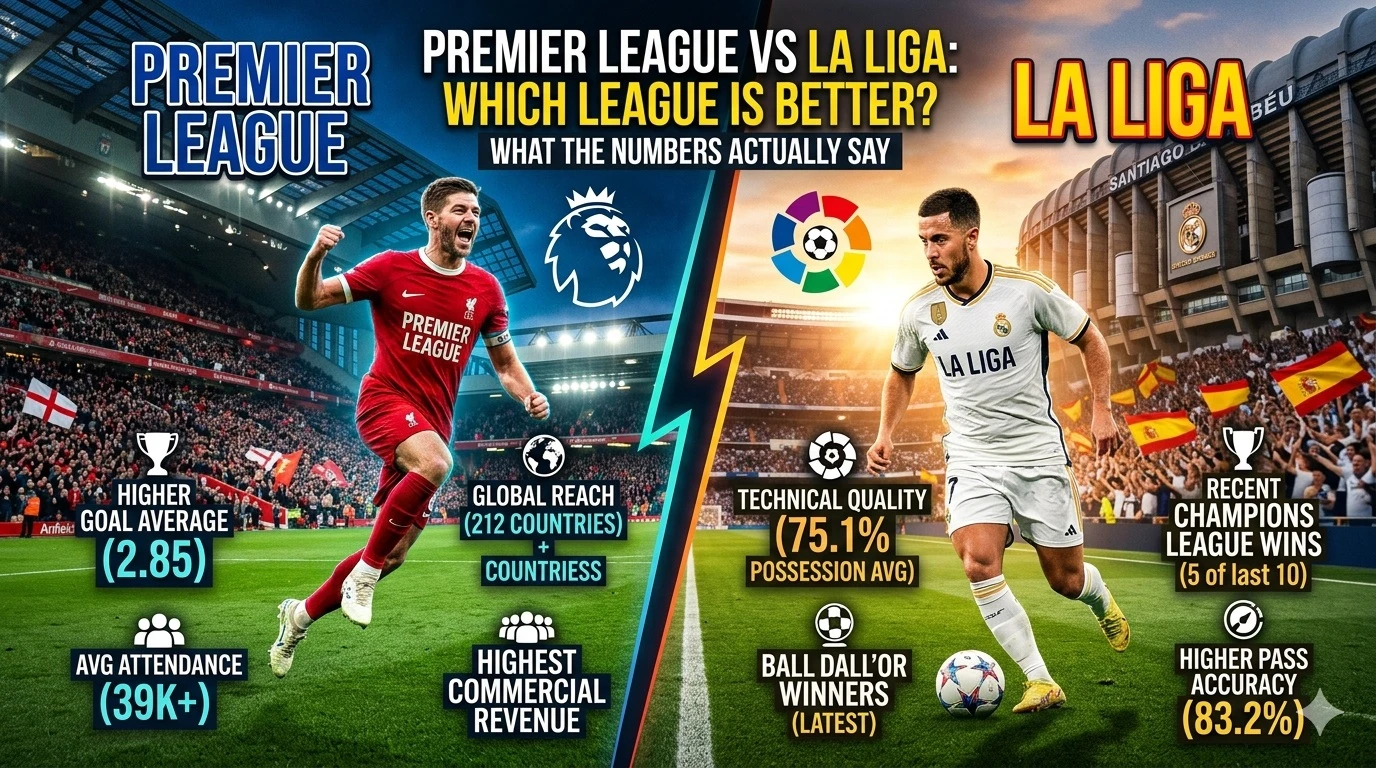
For more than two decades, football fans have argued over one question: Is the English Premier League better than Spain's La Liga?
The debate often turns emotional. Premier League supporters point to the league's intensity, packed stadiums, and fierce competition. La Liga fans counter with the dominance of clubs such as Real Madrid and FC Barcelona, which have shaped modern football history.
But what happens when we look beyond opinions and examine the numbers?
The answer depends on what "better" actually means.
If revenue is the measure, the Premier League is comfortably ahead.
According to Deloitte's football finance reports, Premier League clubs generated a record £6.3 billion in revenue during the 2023-24 season, fueled by television rights, sponsorship deals, and matchday income.
The league's financial strength gives even mid-table English clubs spending power that rivals some of Europe's biggest teams.
The gap is not new. Deloitte analysts previously estimated that the Premier League generated substantially more revenue than La Liga, and that advantage has continued to grow thanks to lucrative domestic and international broadcasting contracts.
Financial power matters because it helps clubs attract talent, invest in facilities, and build deeper squads.
One way to judge league quality is by examining how clubs perform in European competitions.
UEFA's latest association coefficient rankings place England first in Europe and Spain third. England's clubs have accumulated significantly more coefficient points over the past five seasons, reflecting stronger collective performances in the Champions League, Europa League, and Conference League.
England also topped UEFA's season coefficient rankings, indicating that Premier League clubs have been outperforming their Spanish counterparts in recent European campaigns.
This suggests that, as a league, the Premier League currently possesses greater depth.
The story changes when we focus on elite clubs.
No club has won more UEFA Champions League titles than Real Madrid. In recent years, Spanish clubs have continued to demonstrate an ability to compete at the highest level despite operating with less collective revenue than England's top flight.
Real Madrid became the first football club in history to generate more than €1 billion in annual revenue, according to Deloitte's Football Money League. The club remains the highest-earning football institution in the world.
This highlights an important distinction: the Premier League may have more financial depth, but La Liga still contains some of football's most successful and globally influential clubs.
Supporters of the Premier League often argue that its biggest strength is competitiveness.
Unlike many European leagues, where one or two clubs frequently dominate, the Premier League regularly features multiple teams competing for Champions League qualification and European places.
Research examining competitive balance in English football found that the Premier League remains one of the most analysed competitions in the world because of its unpredictability and global appeal, although competitive balance has evolved.
Meanwhile, critics of La Liga argue that the title race has historically been dominated by Real Madrid and Barcelona, with occasional challenges from clubs such as Atlético Madrid.
That does not necessarily mean La Liga lacks quality. It simply means excellence is often concentrated among fewer clubs.
Popularity is another measure.
The Premier League enjoys enormous global television audiences and attracts viewers from virtually every continent. Its international marketing strategy and broadcast reach have helped transform it into football's most commercially successful domestic competition.
However, La Liga benefits from the worldwide appeal of clubs such as Real Madrid and Barcelona, two of the most recognisable sports brands on Earth.
You can watch all types of football matches on the RTS TV APK.
In many regions, fans follow Spanish football primarily because of these clubs rather than the league as a whole.
The statistics suggest there is no single answer.
If the criteria are revenue, squad depth, global broadcasting power, and overall league strength, the Premier League currently holds the advantage. UEFA rankings and financial data strongly support that conclusion.
If the criteria are historic success, elite club achievements, and Champions League pedigree, La Liga remains a formidable rival, thanks largely to Real Madrid and Barcelona.
In simple terms, the Premier League appears to be the strongest overall in 2026. But when it comes to producing some of football's greatest clubs and most iconic European triumphs, La Liga continues to set the standard.
The numbers favour the Premier League. The history books still give La Liga a powerful argument.
Outdoor play gives children a chance to move, explore, and create their own imaginative adventures a
24 September 2026
World777 is a name commonly searched by users who want information about online sports access, accou
16 July 2026
Be the first to share your thoughts
No comments yet. Be the first to comment!
Share your thoughts and join the discussion below.