Saturday, October 24, 2026

Saturday, October 24, 2026
* All product/brand names, logos, and trademarks are property of their respective owners.
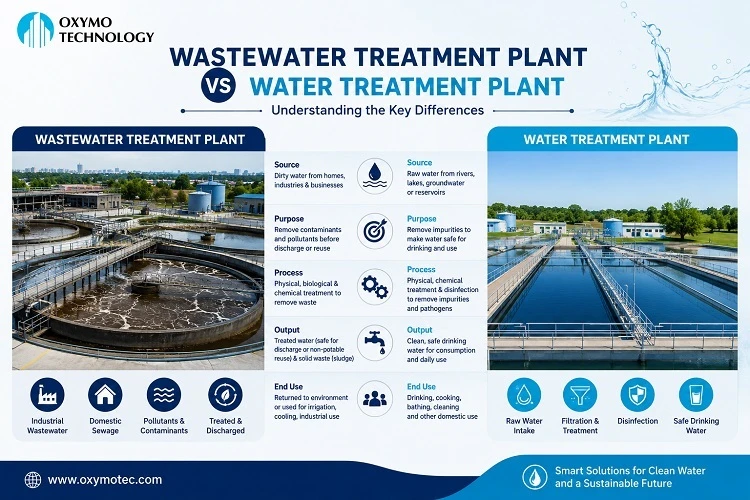
A water treatment plant and a wastewater treatment plant may sound alike, but they serve different purposes and are designed for different types of water. Choosing the right system affects regulatory compliance, operating costs, equipment selection, and long-term plant performance.
Both systems improve water quality, but treat different types of water, use different treatment methods, and have different goals. Knowing the difference can prevent costly mistakes, whether you are designing a new industrial facility, upgrading an existing treatment system, or considering a new supplier. This guide explains the key differences, common applications, treatment technologies, and the factors to consider when choosing the right system.
Let's take a look at the two systems side by side.
|
Water Treatment Plant |
Wastewater Treatment Plant |
|
|
Input |
Raw groundwater, river water, or lake water |
Sewage and industrial effluent |
|
Primary goal |
Water for other uses such as drinking and process water |
Safe discharge or reuse |
|
Contaminant load |
Low to moderate |
High levels of organic matter, pathogens and chemicals. |
|
Core processes |
Coagulation, filtration, disinfection |
Biological treatment, membrane filtration |
|
Governing regulation |
Safe Drinking Water Act |
The Clean Water Act / NPDES |
Both systems enhance water quality but have different initial conditions and desired outcomes. If you are choosing equipment for a commercial/industrial project, it is important to be aware of these differences.
A water treatment plant is designed to produce clean, safe water from natural sources for drinking, manufacturing, or commercial purposes. It removes suspended solids, microorganisms, dissolved minerals, and chemical contaminants to achieve the desired quality depending on the application.
A typical water treatment plant consists of the following processes:
Coagulation and flocculation
Sedimentation
Filtration
Disinfection
Drinking water is provided to homes and businesses by municipal water utilities and water treatment facilities. When manufacturing or food/beverage production companies require process water that is purer and more consistent than the municipal water supply, they maintain a separate on-site water treatment system.
A wastewater treatment plant treats wastewater generated by residential, commercial, or industrial facilities. The main purpose is to filter out the pollutants before safe discharge into the environment or use within the facility.
Wastewater contains more contaminants: organic matter, oils, detergents, pathogens, and, in industrial applications, chemicals unique to the facility's processes. The treatment usually consists of three steps:
Primary treatment removes large solids and grit using screens and settling tanks.
Secondary treatment involves the use of microorganisms to break down dissolved organic matter; typically, an activated sludge process or a membrane bioreactor is used.
Tertiary treatment removes the remaining nutrients, pathogens, and fine particulates from the water by filtering or disinfecting the water before discharge or reuse.
In the United States, the NPDES permit program in the Clean Water Act regulates wastewater treatment plants, and plants that do not comply are subject to real regulatory and economic penalties.
The right choice depends on your water source, treatment objectives, discharge requirements, and whether treated water will be reused.
Choose a Water Treatment Plant if:
You must have drinking water.
You need process water to produce the product.
The source is groundwater, surface water, or municipal supply.
The objective is to purify the water.
Your facility generates industrial wastewater.
You intend to reuse treated water.
You must comply with all environmental regulations.
Choosing an inappropriate treatment system may affect project costs, efficiency, and regulatory compliance. It helps to understand the difference before ordering equipment so you don't have to redesign later on! If the facility manager hires a water treatment plant for sewage, or if the contractor designing a wastewater system assumes it will provide potable water, then the project is likely to face costly redesigns and compliance challenges.
Choosing the right technology option is also important here. Conventional wastewater treatment plants use gravity settling and large clarifiers, which require more maintenance and a larger installation footprint. An MBR system combines biological treatment with membrane filtration to produce higher-quality effluent in a smaller footprint.
This makes it a practical choice for facilities with limited space or water reuse goals. These benefits can also improve long-term operating efficiency and reduce lifecycle costs.
The manufacturer you work with is as important as the technology you use, whether you are building a water or wastewater treatment plant.
Look for a manufacturer that:
Understands your influent water quality
Customizes treatment plans.
Uses certified components
Provides commissioning and after-sales support
Has experience in projects similar to yours
Oxymotec designs and manufactures compact, low-sludge MBR wastewater treatment systems, custom-designed for each site, ranging in size from 5 KLD to more than 1000 KLD, and serving housing developments, hotels, hospitals, and industrial facilities throughout the United States.
What is the difference between Drinking Water Treatment and Wastewater Treatment?
Drinking Water Treatment is used to make raw water safe for drinking or industrial use. Wastewater treatment is a process that removes pollutants from used water and can release it into the environment or recycle it.
Can treated wastewater be a source for drinking water?
Yes, but after advanced treatment including reverse osmosis, UV disinfection and other purification treatments. The treated wastewater is mostly used for non-potable purposes such as irrigation and cooling.
Which industries need both systems?
A wastewater treatment system may be required in addition to a water treatment system in industries such as food processing, pharmaceuticals, chemicals, textiles, healthcare, and manufacturing.
Is an MBR system suitable for small facilities?
Yes. MBR systems are efficient, small, and suitable for small industrial plants, hospitals, schools, residential areas, and hotels.
Each project has varying water quality, flows, and compliance issues. That's why it's important not to make assumptions or choose a design that is a generic treatment system. Our engineers design every MBR wastewater treatment plant to your specific conditions, ensuring you can lower your operating costs, increase water reuse, and meet environmental standards with peace of mind. Share your project requirements with our engineering team to discuss the right treatment solution for your facility.

I’m a positive and ambitious person who enjoys learning new things, meeting people, and growing through every experience. I value honesty, confidence, and keeping a balanced outlook in life.
The priorities of modern power distribution systems for high-rises and data centers are efficiency,
18 September 2026
In industrial piping and fluid handling systems, choosing a reliable valve is essential for maintain
7 September 2026
This Cummins 6BT is one of the most reliable Cummins diesel engines produced. It's trusted by truck
18 August 2026
Be the first to share your thoughts
No comments yet. Be the first to comment!
Share your thoughts and join the discussion below.