Sunday, October 4, 2026

Sunday, October 4, 2026
* All product/brand names, logos, and trademarks are property of their respective owners.
The priorities of modern power distribution systems for high-rises and data centers are efficiency, safety, and scalability. Power can be distributed in various ways, and the most prevalent methods are busbar trunking systems, bus ducts, and cables. Still, which system gives the best combination of performance, reliability, and cost for your project?
We will examine the Busbar Trunking versus Bus Duct versus Cable in detail to choose the most efficient option for your high-demand installations.
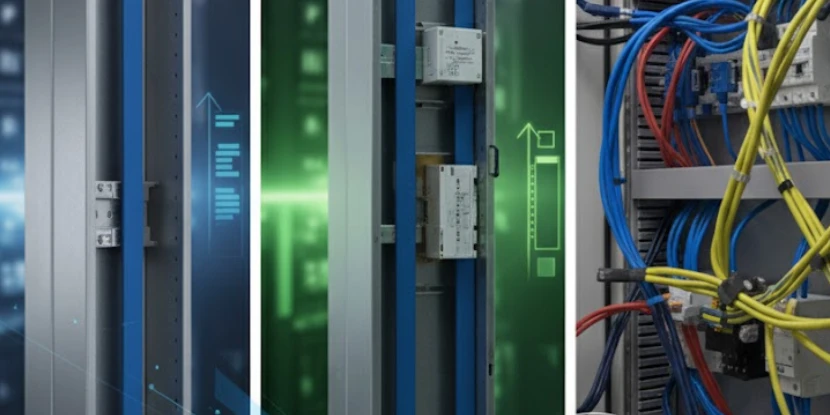
Busbar Trunking System : Busbar trunking system contains pre-fabricated, modular metal enclosures with copper or aluminum conductors inside designed for easy installation and high current-carrying efficiency. The increasing demand for power distribution in large commercial complexes, high-rise buildings, data centers, and factories is positively influenced by its compactness and scalability as mentioned above.
Bus Duct: Bus ducts serve a similar function as busbars but by referring to a customized, non-modular version of busbar trunking the whole thing proves to be a bit more confusing. They are often designed for custom applications connecting transformers to switchboards or large electrical rooms where space is not a major problem.
Cables: Electricity cables are insulated conductors that carry the power from one place to another. They might be the standard in the case of small installations but on the other hand, they could not only be very thick and difficult to handle but also be very user-unfriendly in large-scale vertical applications like high-rise buildings.
Busbar Trunking System : The plus for busbar trunking systems are the plug-and-play modularity, the ease of installation along with minimum civil works, and the compact design that takes up much less space than several parallel cables. In the case of high-rise buildings with limited vertical risers, busbar trunking takes care of power distribution in a neat, organized, and accessible way.
Bus Duct: The installation process of bus ducts is more labor-intensive and involves more manual assembly, alignment and checking. Heavier in general, they take more time to install and hence are not suitable for a building that has limited vertical shafts or a very tight schedule.
Cables: Cables are considerably bigger since the current carrying capacity of one busbar may require several parallel runs of cables. Managing and routing such bulk cables can be very complicated and messy in tall buildings or large data centers.
Busbar Trunking System : Busbar trunking systems have been provided with top-notch safety features. Their metal-clad enclosure greatly reduces the chances of electrical faults, short circuits, and fire incidents. Also, the path has a lower impedance, which in turn means a decrease in energy loss and temperature rise.
Bus Duct: Bus Ducts are reliable nevertheless, sometimes they might be less protected according to the standards set by the manufacturers, and maintenance as well as inspection might consume more time.
Cables: Cables are at a higher risk to suffer insulation damage, overheating, and short circuits—especially when they are bundled together or improperly ventilated. In the case of large buildings, the likelihood of voltage drops and losses is higher.
Busbar trunking systems are the ones that can guarantee the highest level of protection and performance in the most critical like data center applications, which cannot afford outages or safety issues..
Busbar Trunking System: Busbar trunking systems can be easily modified, added to, or reconfigured with minimal downtime which is very important for scalability feature that data centers frequently need when they upgrade their capacity or when moving their equipment becomes necessary.
Bus Duct: Bus ducts have less flexibility because they are usually made specifically for a certain design. Changes usually involve major rework.
Cables: Cables can be easily replaced, but rerouting them is labor-intensive; in addition, they often result in long shutdowns.
Therefore, if your project demands future-ready infrastructure, then a busbar trunking system is the most versatile option.
When looking at it purely from the cost perspective, wires are the cheaper option. Nevertheless, if you include installation time, the quantity of copper used, floor space, and maintenance costs for the whole period, busbar trunking will turn out to be the more cost-effective option in the long run.
• Busbar Trunking: Very low maintenance, very high reliability, and very low power loss.
• Bus Duct: Medium maintenance with moderate efficiency.
• Cables: High Maintenance and Potential for Higher Long-Term Losses
Busbar trunking is still the most balanced and future-oriented option for cost efficiency and long-term performance.
Final Verdict: Which Works Best?
|
Parameter |
Busbar Trunking |
Bus Duct |
Cable |
|
Installation Time |
Fast |
Moderate |
Slow |
|
Space Requirement |
Minimal |
Moderate |
High |
|
Safety |
Excellent |
Good |
Average |
|
Flexibility |
High |
Low |
Moderate |
|
Long-Term Cost |
Low |
Moderate |
High |
|
Ideal For |
High-Rise Buildings, Data Centers |
Industrial Plants |
Small Installations |
Clearly, Busbar Trunking Systems stand out as the best solution for high-rise buildings and data centers, combining safety, efficiency, scalability, and long-term savings.
No matter if you are working on a smart building or on a highly efficient data center, Adinath Enterprises will supply you with their reliable, accurate and well-engineered solutions.
Adinath Enterprises, the top maker of copper and aluminum busbars, and custom-made busbar solutions, guarantees you performance, safety, and quality that you can rely on - giving power to the electrical infrastructures that are the most advanced in India.

No bio available yet.
In industrial piping and fluid handling systems, choosing a reliable valve is essential for maintain
7 September 2026
This Cummins 6BT is one of the most reliable Cummins diesel engines produced. It's trusted by truck
18 August 2026
The slaughter machine line is the backbone of the poultry processing plant in South America, whether
12 August 2026
Be the first to share your thoughts
No comments yet. Be the first to comment!
Share your thoughts and join the discussion below.