Saturday, October 24, 2026

Saturday, October 24, 2026
* All product/brand names, logos, and trademarks are property of their respective owners.
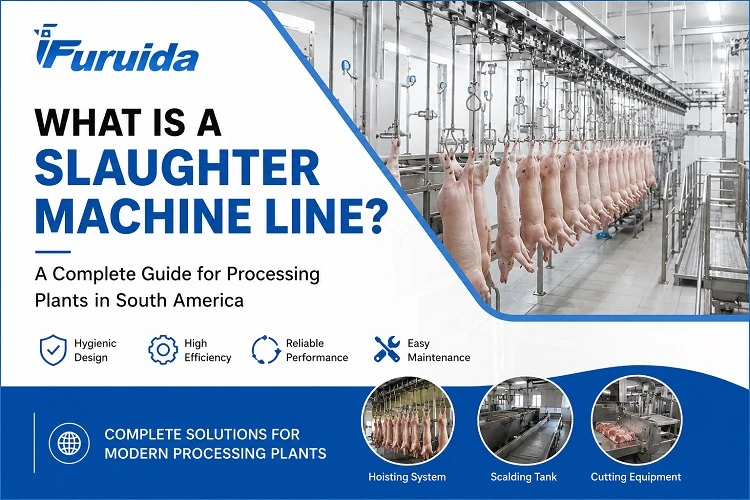
The slaughter machine line is the backbone of the poultry processing plant in South America, whether you are upgrading or setting up a new one. The labour, logistics, and the cold chain depend on this line to work properly.
However, it can be confusing for new buyers or those who have experience with manual or semi-manual setups. So, what does a full line include and how do the stages connect? What should you be thinking about before you invest? This guide answers all of these common questions, which will help you in making a decision.
A slaughter machine line is an integrated system of machines that processes live poultry into carcasses ready for inspection. It happens in a continuous sequence. Each machine handles one stage of the process, as the birds move through the line from one station to the next. They are suspended on an overhead conveyor rail.
The slaughter machine line makes processing fast and consistent. It is not possible with manual handling. The output appears uniform in a well-configured line, and the hygiene standards are also easier to maintain. The labour requirement drops a lot compared to hand processing.
The following stages show the way a poultry slaughter machine line works.
Birds are hung by their feet on shackles attached to the overhead conveyor. They pass through a water-bath stunner or gas stunning system, which renders them unconscious before slaughter. This step is important for animal welfare standards and meat quality, as stressed birds produce lower-quality carcasses.
The birds pass over or through a bleeding table after stunning, where the main blood vessels are cut. The carcass is then left on the line for a set bleeding time of about 90 to 120 seconds before moving forward. Proper bleeding is critical for food safety and the appearance of the final product.
The birds enter a scalding machine, where they are immersed in hot water to loosen the feathers. Water temperature and immersion time are controlled depending on the species and the product type.
Broilers are scalded at 58 to 62°C for soft scalding.
Higher temperatures (above 65°C) are used for hard scalding, which removes the outer skin layer.
Ducks and larger birds require longer scalding times.
Birds move directly into the plucking machine from the scalder. Rubber fingers mounted on rotating drums beat the feathers free from the loosened follicles. Most modern plucking machines remove over 95% of feathers in a single pass. Any remaining pin feathers are removed manually or with a secondary finishing plucker.
Automated head cutters and hock cutters are used for higher-capacity lines. It is done manually on smaller or semi-automatic lines. The feet are collected separately as a by-product for export markets. In Brazil and Argentina, chicken feet have strong demand in Asian export channels.
This is the most critical stage of the entire line to maintain hygiene, as the internal organs are removed at the evisceration table. The chances of contamination are high because of contact between the gut contents and the carcass surface. Evisceration machines open the body cavity and remove the organs on automated lines. Trained operators do the same work at stainless steel workstations in smaller lines.
After evisceration, it is time to wash the carcasses internally and externally. This step removes blood, residue, and any contamination from the previous stage. Most lines use spray-wash systems with clean water under pressure.
Carcasses are cooled to below 4°C to stop bacterial growth and meet food safety requirements in this stage. The following two methods are common.
Water immersion chilling uses a large tank of chilled water and is widely used in Brazil and Argentina.
Air chilling uses cold air tunnels and is preferred in export markets due to lower water absorption in the final product.
Carcasses are graded by weight and quality before packing. They are either packed whole or moved to a cutting line to get the breast, thigh, leg, and wing portions. Vacuum packing machines do the final packaging on integrated lines.
There are a few things specific to the South American context that you should be mindful of.
Regulatory compliance: Plants under federal inspection must meet MAPA standards in Brazil. SENASA governs processing requirements in Argentina. You need to confirm that the line meets the requirements in your country before ordering.
Capacity planning: Always buy considering the future handling capacity, not where it is today. It can be expensive to retrofit a line to increase capacity later.
Space and utilities: Slaughter machine lines require floor space, drainage capacity, water pressure, and power supply to work properly. Confirm all of these against your facility specs before finalising the equipment.
Customisation: Standard catalogue lines are built for average conditions. Look for a manufacturer who will configure the line to your requirements. This is important if your facility has a non-standard layout, or you process a certain bird type.
After-sales support: Spare parts, technical support, and maintenance access are also necessary when the line is running. Go with manufacturers who have established export and support channels for South America.
A slaughter machine line is the core of your processing operation. The output depends on the bird quality, hygiene compliance, labour cost, and daily throughput to run the line. You can sort manufacturers and make the investment decision only after understanding how each stage works and what to look for before you buy.
You can also reach out to the Furuida team if you want a new processing plant or to upgrade an existing line in South America. They can help you with configuration to suit your specific capacity, facility, and budget requirements.
What is included in a standard slaughter machine line?
Stunning, bleeding, scalding, plucking, evisceration, washing, and chilling are part of the standard lines. However, cutting and packing equipment is sold separately. Many manufacturers also offer it as part of a complete processing solution.
What capacity slaughter machine line do I need?
t depends on your daily bird volume. You can divide your total daily target by your working hours to get your required BPH. For example, a plant targeting 4,000 birds in an eight-hour shift needs 500 BPH. Always add a buffer of 15 to 20% above your current requirement to allow for volume growth.
How long does it take to install a slaughter machine line?
A compact and pre-integrated line can be operational within days of delivery, as it arrives as a single unit. Larger, modular lines are assembled on-site and take one to three weeks to install and commission. It also depends on the facility and the complexity of the configuration.
Can a slaughter machine line process different bird types?
Most lines are configured for broilers. Processing ducks, turkeys, or larger birds requires different scalding temperatures, longer processing times, and different plucking equipment in some cases. You can discuss with your manufacturer if you process more than one species.
What is the typical lifespan of a slaughter machine line?
A well-built stainless steel slaughter machine line should last 10 to 15 years if you follow proper maintenance. The rubber plucking fingers, the scalder heating elements, and the conveyor chain can wear out easily, so keep spare parts in your facility.

I’m a positive and ambitious person who enjoys learning new things, meeting people, and growing through every experience. I value honesty, confidence, and keeping a balanced outlook in life.
The priorities of modern power distribution systems for high-rises and data centers are efficiency,
18 September 2026
In industrial piping and fluid handling systems, choosing a reliable valve is essential for maintain
7 September 2026
This Cummins 6BT is one of the most reliable Cummins diesel engines produced. It's trusted by truck
18 August 2026
Be the first to share your thoughts
No comments yet. Be the first to comment!
Share your thoughts and join the discussion below.