Tuesday, October 6, 2026

Tuesday, October 6, 2026
* All product/brand names, logos, and trademarks are property of their respective owners.
Anyone who has researched a topic online knows the routine. You type a query, open eight tabs, skim three articles that say roughly the same thing, and lose twenty minutes before you find one useful paragraph. The information exists. Getting to it is the slow part.
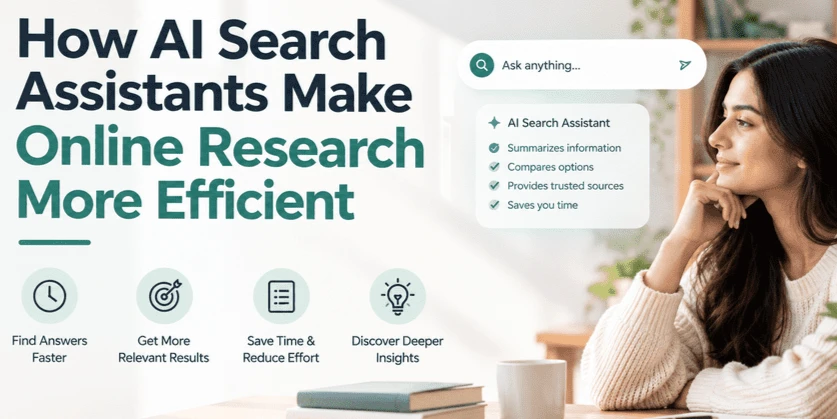
AI search assistants change that routine. Instead of handing you a list of links to sort through, they read, compare, and summarize information on your behalf, then point you to where it came from. Used well, they make online research more efficient without making it careless.
This article explains where these tools genuinely save time, where they fall short, and how to use them so your research stays accurate and trustworthy.
A traditional search engine matches your keywords to pages and ranks them. You do the reading and the synthesis.
A Deepcheck AI Search Assistant works differently. It interprets your question in plain language, pulls information from multiple sources, and assembles a direct answer. Many also let you ask follow-up questions, so the conversation builds on what you already learned instead of starting over with each new query.
Think of it as the difference between being handed a stack of books and being handed a briefing with a reading list attached. The briefing is faster. The reading list is what keeps it honest.
Understanding a new topic quickly. Starting research on an unfamiliar subject is often the hardest stage. You do not know the vocabulary, the major debates, or which questions to ask. An assistant can give you a clear overview in minutes, defining terms and outlining the main viewpoints, so you begin with a map instead of a blank page.
Asking questions the way you think them. Search engines reward carefully chosen keywords. Assistants understand natural phrasing. You can ask, "Why do some companies prefer subscription pricing over one-time fees?" and get a structured answer, rather than guessing which keywords will surface it.
Combining information from several sources. Pulling together facts from multiple pages is tedious work. Assistants can compare viewpoints, highlight where sources agree, and flag where they differ. That alone can cut the most repetitive part of research.
Following up without losing context. Because the conversation carries forward, you can narrow a topic step by step. "Now focus on small businesses." "What are the main criticisms?" "Explain that more simply." Each question builds on the last, which saves the effort of rewriting queries from scratch.
Handling long documents. Many assistants can summarize reports, articles, or papers you provide. This helps you decide quickly whether a lengthy document deserves a full read, and where to focus if it does.
The benefits look different depending on what you are working on.
Students can use them to clarify difficult concepts, generate study questions, and find angles for essays, while still doing their own reading and writing.
Professionals can use them to prepare for meetings, scan industry developments, or compare options before making a recommendation.
Writers and marketers can use them to check how a topic is commonly framed, spot gaps in existing coverage, and gather starting points for deeper reading.
Everyday users can use them for practical decisions: comparing product types, understanding a medical term before talking to a doctor, or planning a trip. For anything health, legal, or financial, treat the answer as a starting point and confirm with a qualified professional.
Speed is only valuable if the answer is right, and this is where discipline matters.
AI assistants can make mistakes. They may misread a source, present an outdated fact as current, or state something with more confidence than it deserves. Some can produce details that sound plausible but are simply wrong. The cleaner and more fluent the answer reads, the easier it is to trust it without checking.
A few habits protect you:
The most efficient researchers treat the assistant as a fast first pass, not the final word.
Here is a practical way to combine speed with accuracy:
This approach keeps the speed benefits at the start, where research is slowest, and keeps human judgment where it counts.
AI assistants are not a replacement for every kind of search. A standard search engine is often better when you want to browse many perspectives, find a specific website, locate local businesses, check live results, or explore a topic with no clear question yet. It also gives you a wider view of what exists, which can matter when you are looking for something unusual.
The best researchers use both, switching tools depending on the task.
Be thoughtful about what you share. Avoid entering confidential business information, personal identifiers, or private documents unless you understand how the tool handles data. Check the privacy settings and policies of whichever assistant you use, particularly for workplace use.
It also pays to be transparent. If you rely on AI-assisted research in professional or academic work, follow the rules and expectations of your organization or institution.
AI search assistants make online research more efficient by doing the slow, repetitive parts: gathering, comparing, and summarizing. That frees you to spend your time on the parts that need a human, such as judging quality, weighing evidence, and deciding what it all means.
Use them as a sharp starting point, verify what matters, and keep your own thinking in charge. Done that way, you spend less time wading through tabs and more time understanding what you found.

Pre-fab building has come a long way from the temporary homes of the 1940s. Modern modular units are
30 September 2026
The term Acamento has attracted growing attention online, particularly in articles discussing finish
24 September 2026
In today's fast-paced business and event industry, Audio Visual Services play a vital role in creati
30 July 2026
Be the first to share your thoughts
No comments yet. Be the first to comment!
Share your thoughts and join the discussion below.