Sunday, October 4, 2026

Sunday, October 4, 2026
* All product/brand names, logos, and trademarks are property of their respective owners.
When a corner starts chipping, cracking, or scuffing, the instinctive response is often to reach for the toughest, most heavy-duty wall corner protector available. But durability is only one factor in the decision. The right choice should be made by weighing up impact risk, appearance, the shape of the wall, the environment it sits in, and how easily it can be fitted — not simply by picking the material with the highest resistance rating.
A lightweight strip that suits a quiet residential hallway would look and feel completely out of place bolted to a loading bay pillar, just as an industrial rubber buffer would be a heavy-handed, unattractive solution for a freshly decorated home office. This guide works through the main material options — standard PVC, flexible PVC, clear PVC, wood-effect PVC, aluminium and rubber — and looks at where each type of wall corner protector genuinely earns its place.
A wall corner protector is a purpose-made guard fitted over an exposed wall edge to shield it from everyday knocks, scuffs and impact damage. They're used wherever corners are at risk from furniture, trolleys, luggage, wheelchairs, vehicles or general foot traffic, and are available in a range of materials, sizes, colours and finishes to suit different settings.
Homes, offices, schools, healthcare buildings, retail units and warehouses all rely on wall corner protectors in different forms, which is why the right material varies so much from one space to another.
Not every corner is a perfect right angle. Older properties, curved stairwells, bay windows and awkward building junctions often present angles that are slightly more or less than 90 degrees, and a rigid profile simply won't sit flush against them. Flexible PVC profiles are designed to bend and adapt to these irregular edges, closing gaps that a fixed wall corner protector would leave open.
Where the wall itself is the feature — a decorative paint finish, wallpaper, a mural, or simply a colour scheme the owner doesn't want interrupted — a transparent wall corner protector allows the protection to do its job without drawing attention to itself. Clear PVC is popular in rental properties, show homes, hotels and offices where landlords or designers want impact protection without visually competing with the interior.
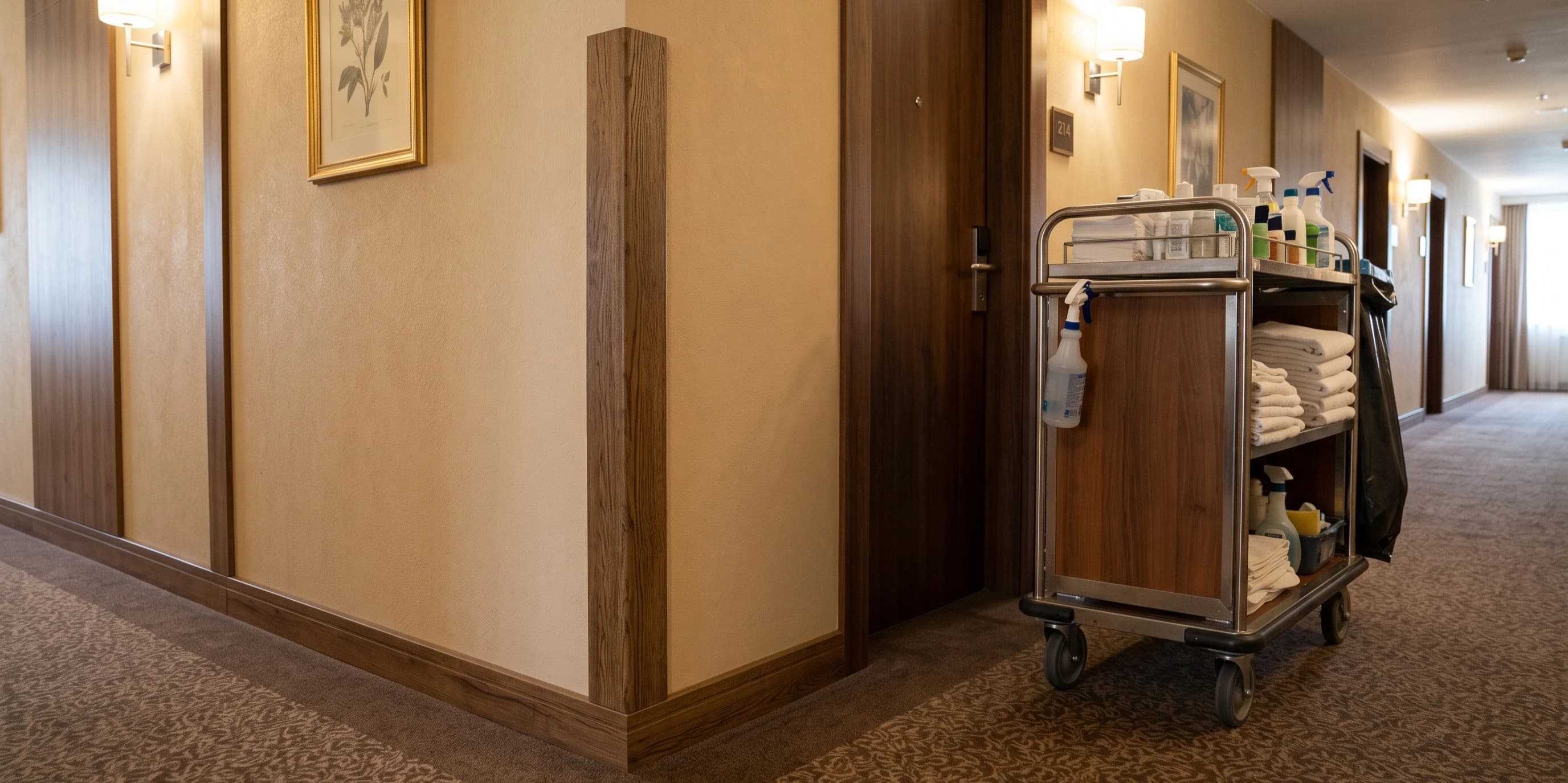
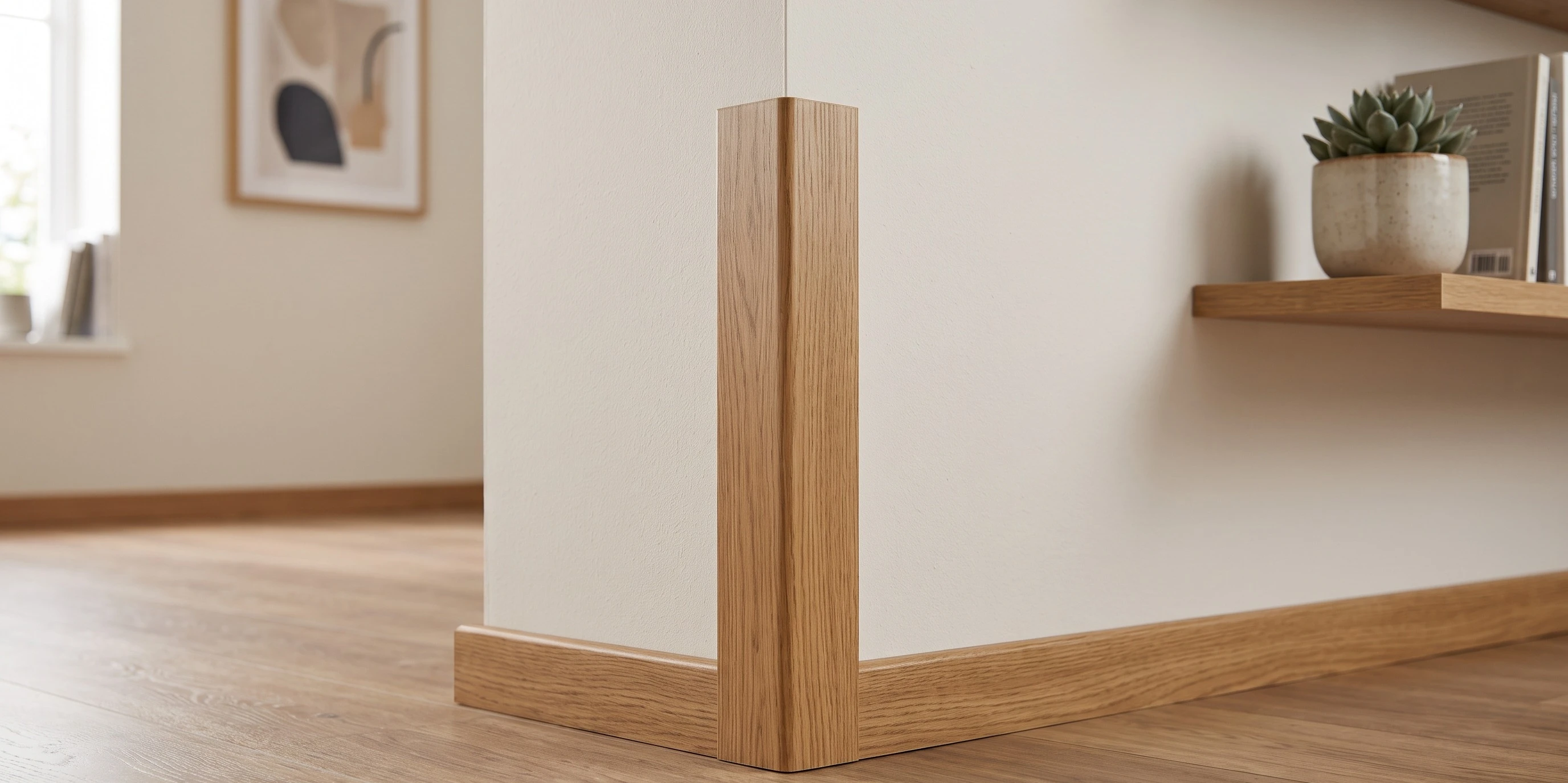
Many interiors — particularly those with wood-effect skirting, doors, flooring or furniture — call for a wall corner protector that blends in rather than standing out as an obvious add-on. Wood-effect PVC profiles replicate the appearance of timber finishes while retaining the practicality, weight and price point of PVC. This makes them a natural choice for traditional interiors, period-style renovations, hotels and any setting where a plain white or grey strip would look out of place against warmer, more textured surroundings.
Aluminium sits at the more premium end of the corner-protection spectrum. It's lightweight yet considerably stronger than PVC, naturally corrosion-resistant, and has a clean, contemporary appearance that suits modern retail fit-outs, commercial receptions, kitchens and bathrooms. Because it can be cut, drilled and finished (anodised, powder-coated or left in a brushed finish), an aluminium wall corner protector is often favoured by shopfitters and contractors working on bespoke or higher-specification projects.
Rubber comes into its own where the risk is genuinely severe: warehouses, loading bays, workshops, car parks and anywhere vehicles, forklifts, trolleys or heavy machinery operate close to structural corners. Its density and shock-absorbing properties make it far better suited to real impact risk than to everyday decorative use. In a home, office or retail environment, a bulky rubber wall corner protector is usually unnecessary and can look heavy-handed against finished interiors.
The underlying principle is consistent throughout: match the protection to the actual risk and setting, rather than defaulting to whichever material sounds toughest.
Check with a spirit level or angle finder before choosing a profile. Many older properties and converted buildings have corners that are slightly more or less than square, in which case a flexible PVC profile will sit flush where a rigid one would leave a gap.
Yes, a rigid standard profile is designed for true right angles. For bowed walls, curved stairwells or slightly uneven corners, a flexible PVC profile is generally the better fit.
WallCornerProtectors.Co.UK stock a broad range of PVC, flexible, unequal-angle, wood-effect, aluminium and rubber options side by side, making it easier to compare finishes, sizes and price points before deciding what suits a particular corner.
There's no single "best" wall corner protector — only the best option for a given corner, environment and level of risk. A domestic hallway rarely needs the bulk of rubber, and a forklift zone shouldn't be relying on decorative PVC.
By weighing up impact risk, wall geometry, appearance and installation method together, homeowners, designers, landlords and facilities managers can choose protection that does its job without looking out of place — or, just as importantly, without leaving corners under-protected where it genuinely matters.

A home elevator can make everyday movement between floors more convenient, especially in multi-store
25 September 2026
Stairs get more daily wear than almost any other part of a building, yet the edge of each step is of
18 September 2026
Staircases are among the most heavily used — and most overlooked — areas of any building
10 September 2026
Be the first to share your thoughts
No comments yet. Be the first to comment!
Share your thoughts and join the discussion below.
.webp&w=3840&q=75)