Monday, July 27, 2026

Monday, July 27, 2026
* All product/brand names, logos, and trademarks are property of their respective owners.
Industrial and construction sites are often busy, high-traffic environments where clarity and organisation are crucial. Large floors, hard surfaces, and constant movement can quickly create hazards if pathways, zones, and boundaries aren’t clearly defined. Line marking plays a key role in guiding movement, reducing accidents, and keeping spaces structured. Beyond aesthetics, well-applied markings improve workflow and safety. When combined with durable, anti-slip coatings, they offer a practical, long-lasting way to maintain order and protect people across industrial areas.
Safety is one of the most significant challenges in industrial and construction settings. Large open areas, mixed-use zones, and constant foot traffic all increase the potential for accidents if environments are not clearly structured.
Slips, trips, and falls remain one of the most common causes of workplace injuries in the UK, particularly in environments dominated by concrete, asphalt, and tarmac surfaces. These materials are durable but can become smooth over time, especially in areas exposed to moisture, dust, or repeated wear.
Line marking paints designed with anti-slip properties help address this risk by adding surface grip while clearly identifying safe routes and zones. Instead of relying solely on signage or temporary measures, anti-slip line markings provide a permanent, highly visible solution that actively reduces risk underfoot.
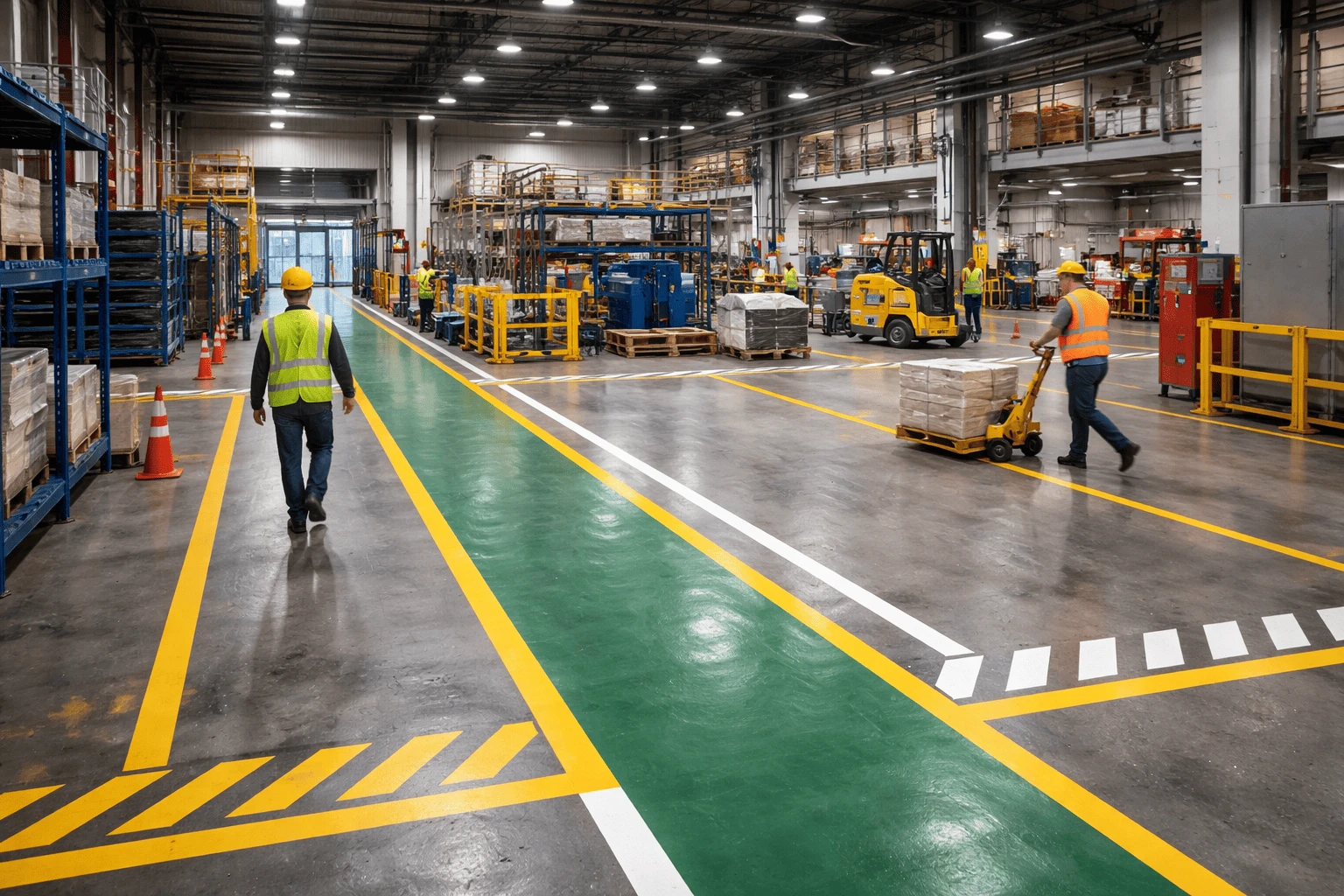
Clear boundaries are essential in busy industrial spaces. Marked pedestrian routes, controlled access areas, and designated zones help people understand where they should walk and where extra caution is required. This reduces uncertainty and supports safer decision-making, particularly in environments where multiple activities happen at once.
Durable line marking paints ensure these safety zones remain visible even under heavy use. When markings fade or wear away, confusion increases, and safety standards can quickly slip. Consistent, well-maintained markings play a key role in reinforcing a culture of safety across industrial sites.
In addition to safety, line marking has a direct impact on how efficiently industrial spaces function. Poor organisation often leads to congestion, inefficient movement, and avoidable downtime.
Industrial buildings frequently experience constant movement between entrances, work zones, and access routes. Without clear visual guidance, people may take inefficient paths or cross into unsuitable areas, disrupting workflows.
Line markings provide immediate, intuitive guidance. Clearly defined walkways and zones help streamline movement, reduce unnecessary cross-traffic, and improve overall site flow. Over time, this clarity supports smoother daily operations and reduces friction within busy environments.
Industrial markings must withstand heavy wear. Constant foot traffic, friction, and exposure to light can quickly degrade lower-quality coatings, leading to faded or unclear lines.
High-performance line marking paints are designed to retain colour and definition over time. UV resistance and flexible formulations help ensure markings remain visible and intact, even in demanding conditions. This durability reduces the need for frequent repainting and helps maintain consistent organisation across large areas.
Hard flooring is a defining feature of industrial and construction environments, but it also presents specific safety challenges. Anti-slip performance is therefore a key consideration when selecting line marking materials.
Smooth hard surfaces can become hazardous without proper treatment. Standard paints may offer visual definition but often fail to provide sufficient grip. Anti-slip line marking coatings address this by combining visibility with traction, making them far better suited to industrial use. Products formulated for these surfaces often include textured additives that enhance grip without compromising durability. This makes them suitable for areas where safe movement is essential, such as walkways, access points, and frequently used zones.
Industrial floors are subjected to repeated stress. Foot traffic, friction, and daily use can quickly wear down coatings that are not designed for such conditions. Flexible, high-quality acrylic formulations are better able to cope with this pressure. Rather than cracking or breaking down, they maintain a consistent finish that supports long-term safety and organisation. This resilience is especially valuable in environments where access restrictions for maintenance are difficult to manage.
Even among various options for floor safety and organisation, certain Line Marking Paints provide an effective balance of durability, grip, and long-term performance. These paints are designed to withstand heavy use while maintaining clear visibility and consistent surface control. Materials with anti-slip properties and strong resilience can help improve both safety and workflow in industrial environments. When choosing a solution, it’s useful to focus on functional qualities such as UV resistance, flexibility, and surface texture rather than specific brands.
Even the highest-quality materials rely on correct application to deliver long-term results. Preparation and technique are key to ensuring durability and performance.
Surfaces should always be clean, sound, and completely dry before application. Dust, debris, grease, or moisture can compromise adhesion and reduce effectiveness. For external areas, it is also important to ensure that no rain is forecast on the day of application. Proper preparation helps maximise the lifespan of the coating and ensures that anti-slip properties perform as intended.
Anti-slip coatings typically require thorough mixing to ensure textured particles are evenly distributed. Application is typically best achieved with a brush and roller, which allows for consistent coverage and a smooth surface texture. Applying two coats with adequate drying time between layers helps achieve a uniform, durable finish. While drying times vary depending on the conditions, allowing sufficient ventilation and curing time is crucial for achieving long-term performance.
From a practical perspective, long-term value matters just as much as initial performance. Durable line marking solutions help reduce ongoing maintenance and operational disruption.
Frequent repainting can be disruptive and costly, particularly in active industrial spaces. Coatings designed for durability and heavy use reduce how often markings need to be refreshed, saving time and resources.
Consistent, clearly defined markings contribute to a safer working environment and support a more professional site appearance. Over time, this combination of safety, clarity, and reduced maintenance delivers tangible benefits for industrial operators.
Line marking plays a foundational role in shaping how industrial and construction spaces function. Thoughtful implementation improves safety, enhances organisation, and supports efficient movement across complex environments. Anti-slip performance, durability, and long-term visibility are all key factors in ensuring markings remain effective over time.
By understanding the importance of surface performance, correct application, and material selection, industrial sites can create environments that are safer, easier to manage, and more efficient. Clear, durable markings help bring structure to busy spaces, reduce risk, and support smoother daily operations. For more insights and guidance on industrial surface solutions, visit industrialmaterial.uk.

I am Oliver, a blog writer who enjoys creating clear, engaging, and meaningful content for readers. I like exploring different topics and turning ideas into simple, easy-to-understand articles that provide real value. My focus is on writing in a natural and creative way so readers can stay interested and connected. Through my blogs, I aim to inform, inspire, and share useful insights with my audience.
In UK construction, sealing isn’t just a finishing touch — it’s what keeps buildin
14 February 2026
In the UK construction and building sector, keeping outdoor areas safe, durable, and protected is an
2 February 2026
From muddy boots and scattered tools to slippery walkways and soaked site entrances — UK const
30 January 2026
Be the first to share your thoughts
No comments yet. Be the first to comment!
Share your thoughts and join the discussion below.




11.webp&w=3840&q=75)