Sunday, October 4, 2026

Sunday, October 4, 2026
* All product/brand names, logos, and trademarks are property of their respective owners.
In the UK construction and building sector, keeping outdoor areas safe, durable, and protected is an ongoing concern. Landscaped zones, communal spaces, and play areas often sit alongside active construction, making it challenging to preserve usable ground surfaces. Grass and soil can quickly suffer from heavy foot traffic, temporary access routes, and changing weather, leading to uneven patches and trip hazards. These issues are particularly important when areas are accessible to residents or children before a project is finished. Using solutions that support stability and safety while allowing spaces to remain functional is essential for builders and site managers.
During construction, grassed areas often serve multiple purposes. They may be designated as future landscaping features, temporary access points, or communal spaces that need to remain intact throughout the project. Without protection, repeated use can compact soil, damage root structures, and leave surfaces uneven and difficult to reinstate.
Rubber grass mats help address this by distributing loads across a wider surface area, reducing pressure on the ground beneath. This allows grass and soil to remain more stable, even in areas exposed to regular foot traffic. As a result, contractors can preserve the condition of landscaped spaces while maintaining access during key phases of work. This approach also supports phased construction programmes. Mats can be installed, removed, and repositioned as site layouts evolve, offering flexibility without compromising ground integrity.
Safety considerations extend beyond the immediate construction zone, particularly on developments where outdoor areas may be used early by residents or the public. Uneven grass, worn pathways, and muddy patches can all contribute to accidents, especially in wet conditions.
Rubber grass matting improves surface consistency, helping to reduce slips and trips while maintaining a natural appearance. For projects that include family-oriented spaces, such as housing developments or schools, this added stability is an important factor in meeting safety expectations. The result is an outdoor environment that feels more secure while still blending into its surroundings.
Playgrounds and informal play spaces are common in many residential and public-sector developments. These areas require careful consideration, as they must remain safe for children while also withstanding regular use and exposure to the elements.
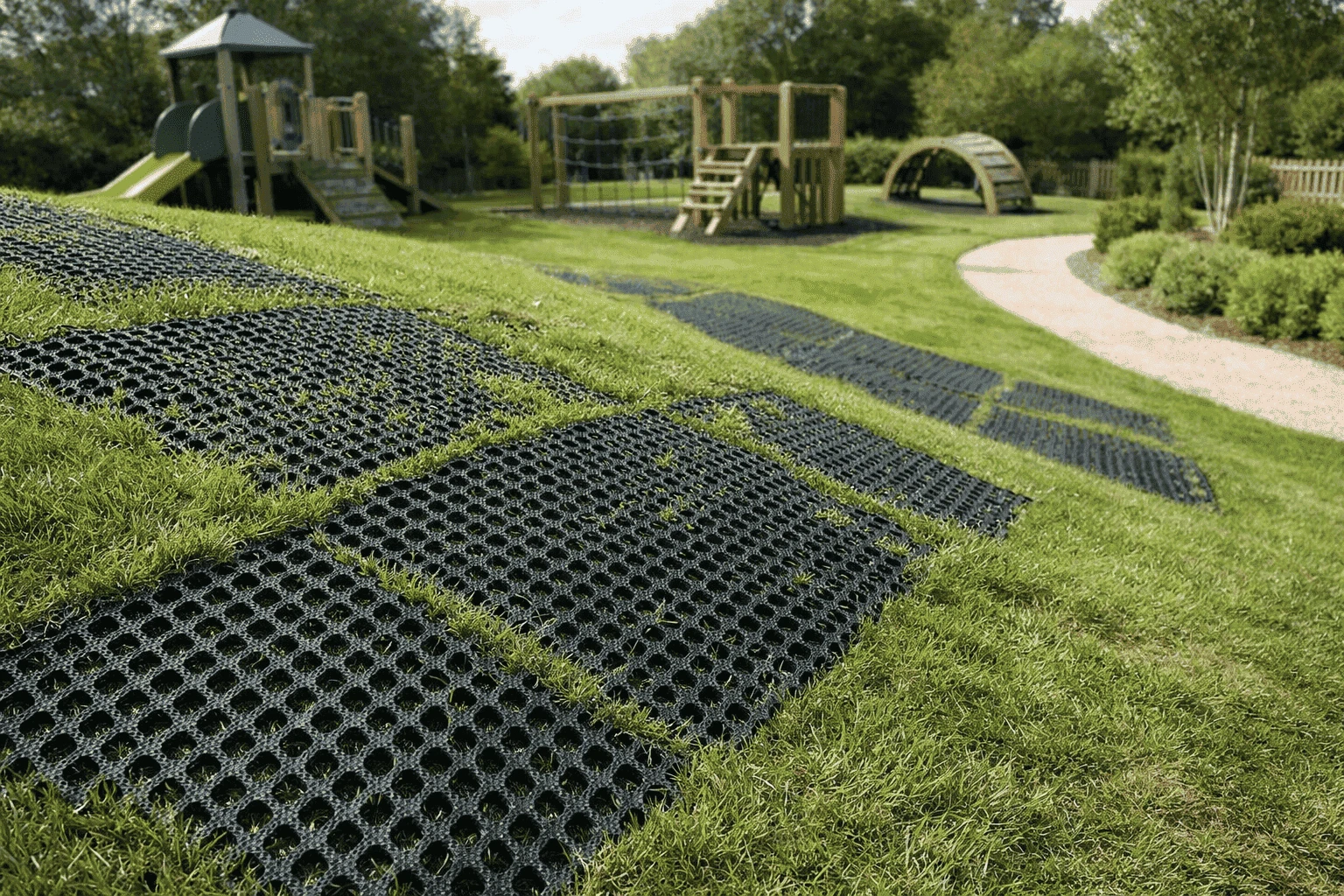
Rubber grass mats used in playground and outdoor settings reinforce play equipment and along movement routes, helping to stabilise the surface without removing natural grass. This makes them suitable for developments that aim to retain a green, open feel while improving safety underfoot.
For example, products within the Rubber Grass Mats category are designed to maintain even surfaces underfoot, distributing loads while allowing grass to grow naturally. These mats can be integrated seamlessly into landscaped play areas without altering the visual character of the space.
UK weather conditions can be challenging for outdoor surfaces, particularly in high-use areas. Prolonged rainfall can soften the ground, leading to pooling water and muddy patches that limit usability and increase maintenance demands.
Rubber grass matting supports drainage and surface stability, helping outdoor areas remain accessible throughout the year. By reinforcing grassed surfaces, mats reduce wear during wetter months and help prevent the formation of bare patches. This contributes to more consistent performance and lowers the need for frequent repairs or resurfacing.
Construction projects often require temporary protection solutions that can adapt to changing site conditions. External works, landscaping, and finishing stages all place demands on grassed areas that may already be completed or partially established.
Rubber grass mats provide a practical form of temporary ground protection during these phases. Installed over grass or soil, they help maintain surface integrity while allowing access for workers and light equipment. This reduces disruption and supports smoother project progression, particularly on sites where outdoor areas are integral to the final design.
From a cost management perspective, reusable solutions offer clear advantages. Rubber grass mats can be lifted and redeployed across multiple phases of a single project or reused on future sites. This reduces reliance on disposable ground coverings and limits the need for repeated ground repairs.
In addition to financial benefits, reusability supports more sustainable construction practices. Minimising waste and preserving existing ground surfaces aligns with environmental objectives increasingly expected across the UK construction industry.
Proper installation plays a key role in the performance of any ground protection system. In outdoor environments, where ground levels may vary, flexible connections help mats adapt to minor movement without creating gaps or raised edges.
Natural rubber floor mat connectors allow mats to be joined while maintaining flexibility. This is particularly useful in playgrounds and landscaped areas, where comfort underfoot and surface conformity are important. Connected mats move slightly with the ground, helping maintain a consistent surface over time.
In areas exposed to higher foot traffic or more demanding conditions, a firmer connection may be required. Black rubber mat connectors provide increased stability, helping to keep mats securely aligned and reducing the risk of separation.
Selecting the appropriate connector ensures that rubber grass mats remain effective throughout their use, supporting both safety and ground protection across different site conditions.
Selecting the right solution begins with understanding how an outdoor area will be used during and after construction. Factors such as expected foot traffic, duration of use, and exposure to weather all influence the most suitable setup.
Ground protection needs may differ between landscaped areas, access routes, and play spaces. Considering these requirements early helps ensure that selected materials perform as intended and integrate smoothly into the wider project plan.
A reliable system combines appropriate mats with suitable connectors to create a stable, continuous surface. This reduces maintenance requirements and improves long-term performance, particularly in environments subject to regular use.
By approaching ground protection as a complete system rather than a standalone product choice, construction professionals can achieve more consistent results across varied site conditions.
Rubber grass mats offer an effective method for managing safety and ground protection challenges on construction and development projects. By reinforcing natural surfaces, they help preserve grass and soil while improving stability in outdoor areas exposed to regular use. This makes them particularly relevant for developments that include communal spaces or play areas.
When combined with appropriate connectors, rubber grass mat systems can adapt to different site conditions and usage demands. Their reusable nature supports both cost control and sustainable construction practices, helping create safer, more resilient outdoor environments. Additional technical guidance on rubber matting systems is available at therubbermats.uk.

UK writer Evan covers home improvement, construction, and lifestyle trends, sharing practical insights for readers.
A home elevator can make everyday movement between floors more convenient, especially in multi-store
25 September 2026
Stairs get more daily wear than almost any other part of a building, yet the edge of each step is of
18 September 2026
When a corner starts chipping, cracking, or scuffing, the instinctive response is often to reach for
14 September 2026
Be the first to share your thoughts
No comments yet. Be the first to comment!
Share your thoughts and join the discussion below.