Sunday, October 4, 2026

Sunday, October 4, 2026

* All product/brand names, logos, and trademarks are property of their respective owners.
Every commercial building takes a beating in places most people never notice — until the damage is already done. Corners are the first casualty. A trolley clips the plaster on its way to the stockroom, a chair leg catches the wall outside a meeting room, a delivery cart scrapes past in a narrow corridor. None of it looks serious in the moment, but over months it turns into cracked drywall, chipped paint, and a maintenance bill that didn't need to happen. A wall corner guard is one of the simplest ways to stop that cycle before it starts.
This article covers why corners are the weak point in any commercial fit-out, the main types of corner guards on the market, and how to pick and fit the right one for your building.
An exposed wall corner isn't just a cosmetic risk — it's a recurring cost. Every knock chips away more paint or plaster, and once the corner bead underneath is exposed, repairs stop being a five-minute touch-up and start needing a plasterer. Multiply that across a building with dozens of corners and constant foot or equipment traffic, and it adds up quickly.
Typical pressure points in commercial buildings include:
The pattern is always the same: it's rarely one dramatic collision that causes the damage. It's the accumulation of small, everyday knocks that a corner guard is specifically designed to absorb.
A wall corner guard is a strip or moulded profile fitted directly over an exposed corner to take the impact that would otherwise hit the wall itself. It sits between the wall and whatever bumps into it — a cart, a chair, a piece of equipment — and absorbs or deflects that force instead of transferring it straight into the drywall or plaster.
Depending on the material and profile, a corner guard can serve two purposes at once:
1. Rigid PVC guards are the standard choice for the heaviest traffic areas — warehouses, loading bays, and busy stockroom corridors. They're built to withstand repeated contact from trolleys and equipment, resist scuffing, and wipe clean easily, though they offer less cushioning than softer materials.
2. Rubber and silicone guards strike a balance between durability and shock absorption. They hold up well to daily contact while keeping a slim, unobtrusive profile — a good fit for office corridors and moderate-traffic walkways.
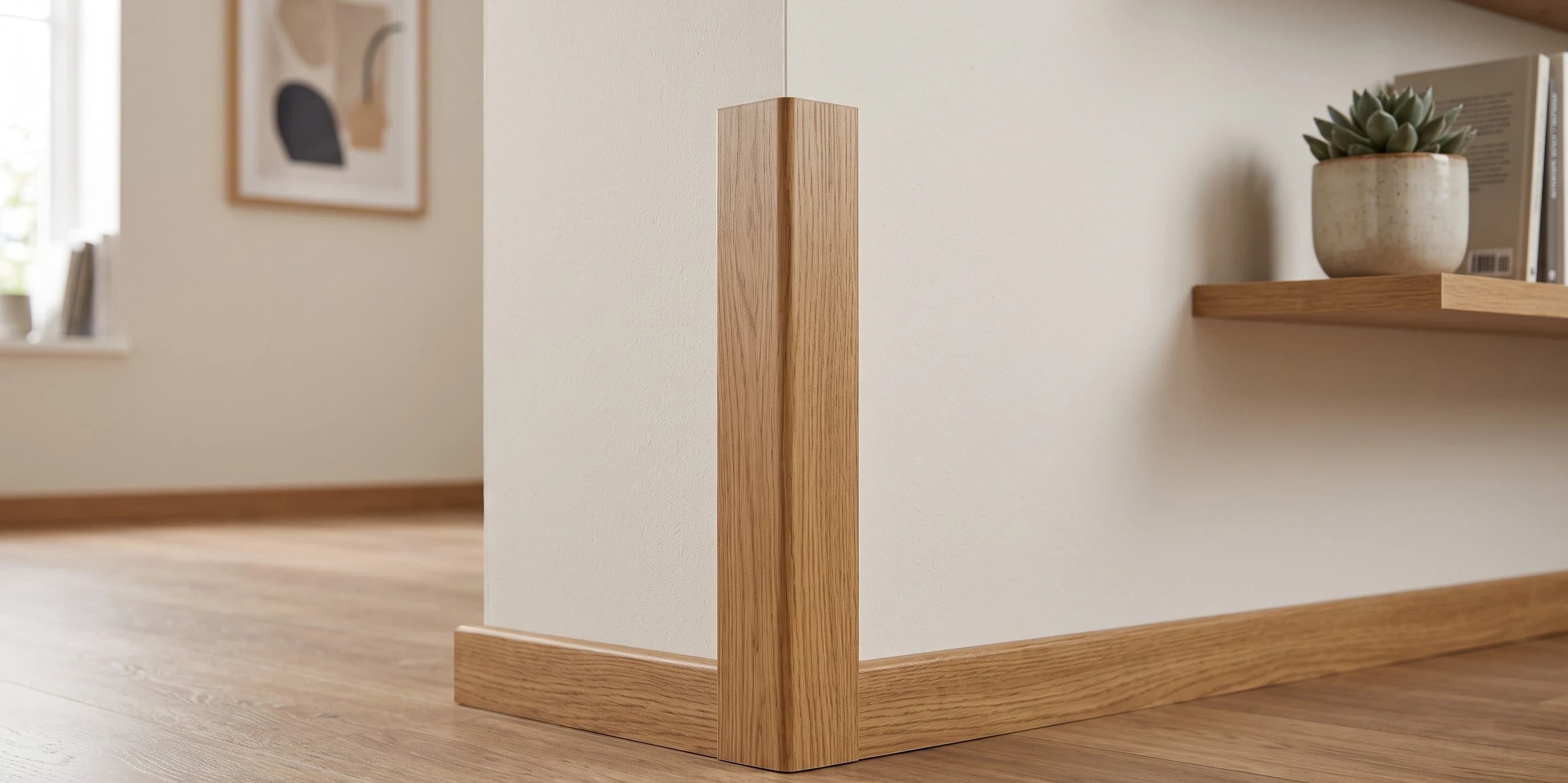
3. Wood effect corner trim is the choice for spaces where appearance matters as much as protection. Made from moulded composite or laminate-wrapped MDF, it's designed to look like genuine timber trim rather than an obvious add-on, which makes it a natural fit for reception areas, hotels, and showrooms. It handles everyday knocks well, though the heaviest impact zones still call for rigid PVC.
4. Clear and low-profile guards protect a corner without changing its appearance much at all. These suit spaces where the priority is preserving a specific paint colour or finish rather than making a visual statement.
A single building often needs more than one type of guard, since not every corner faces the same risk.
Corridors with constant cart or trolley movement need rigid protection. Lower-traffic areas can often use a slimmer rubber or clear guard.
Client-facing spaces benefit from wood effect trim or a low-profile finish. Back-of-house areas like stockrooms are usually better served by function over form.
Freshly painted or leased premises call for adhesive-friendly options that won't damage the surface on removal. Always confirm whether a product is designed for permanent adhesive, a removable strip, or screw fixing before committing to one.
For a look at the range of finishes and styles available, https://www.doorthresholds.co.uk/ is a useful starting point when comparing options for a specific space.
Corner damage is one of the most predictable — and most avoidable — forms of wear in any commercial building. A wall corner guard costs little, takes minutes to fit, and directly prevents the kind of repeated, low-level damage that eventually turns into a real repair job.
Match the guard to the corner — rigid where traffic is heaviest, wood-effect trim where appearance counts, and low-profile where the goal is to protect without being noticed — and it pays for itself many times over.

A home elevator can make everyday movement between floors more convenient, especially in multi-store
25 September 2026
Stairs get more daily wear than almost any other part of a building, yet the edge of each step is of
18 September 2026
When a corner starts chipping, cracking, or scuffing, the instinctive response is often to reach for
14 September 2026
Be the first to share your thoughts
No comments yet. Be the first to comment!
Share your thoughts and join the discussion below.