Sunday, October 4, 2026

Sunday, October 4, 2026
* All product/brand names, logos, and trademarks are property of their respective owners.
In industrial environments, fastening solutions must do more than simply hold components together. They need to enhance operational efficiency, allow for regular access, reduce downtime, and adapt to changing requirements. Across manufacturing, construction, facilities management, and specialist trades, hook & loop fasteners have emerged as a versatile alternative to rigid or single-use fixings.
Initially developed as a reusable fastening system, hook & loop fasteners have evolved to meet industrial standards. Modern variants can withstand frequent handling, vibration, and demanding working conditions while still providing flexibility and ease of adjustment. Their ability to secure items without permanent fixing makes them especially useful in environments where inspection, maintenance, or reconfiguration is common.
These fasteners are now considered an essential component within industrial accessories. Their applications extend from cable management to temporary fixing, textile solutions, display installations, and equipment organisation. Understanding how they work and where they add value can help businesses adopt more efficient and adaptable operational practices. This guide explores the mechanisms of hook & loop fasteners, the advantages they offer, and the industrial applications in which they are most effective.
Hook & loop fasteners consist of two complementary surfaces: one with small, rigid hooks and another with softer loops. When pressed together, the hooks engage the loops to create a secure mechanical bond. Industrial-grade versions are typically made from durable synthetic materials that maintain performance over repeated use. Compared with lightweight consumer products, industrial hook & loop fasteners are designed to resist wear, maintain grip strength, and perform reliably under daily operational stress.
The fastening strength of a hook & loop system depends on the density and engagement of the hooks and loops. Since the bond is mechanical rather than chemical, the fastener can be opened and closed repeatedly without losing effectiveness. This makes it ideal for applications requiring frequent access or adjustments. In industrial settings, this property reduces reliance on tools and allows maintenance teams to work more efficiently, particularly during inspections or system upgrades.
Hook & loop fasteners are used extensively because they provide a balance between secure fixing and operational flexibility. They help prevent surface damage, support workplace safety by eliminating sharp edges, and contribute to cleaner, more organised installations. Their compatibility with a wide range of materials—including metals, plastics, fabrics, and composites—makes them applicable across multiple industries.
A primary advantage of hook & loop fasteners is the speed of installation. With no drilling or specialist tools required, components can be secured or repositioned quickly. In fast-paced industrial environments, this efficiency can positively impact overall productivity.
Hook & loop fasteners are designed for repeated use, helping reduce material waste compared to single-use alternatives. Their reusability contributes to better cost management and aligns with sustainability initiatives by limiting unnecessary disposal.
Traditional fixings may involve rigid edges, breakage risks, or sharp components. Hook & loop fasteners provide a softer solution, lowering the risk of injury and making them suitable in environments where personnel frequently interact with installed systems.
Many industrial operations require temporary or non-permanent fixing. Hook & loop fasteners allow components to be removed without damaging surfaces, which is particularly valuable in finished interiors, rented premises, or clean environments.
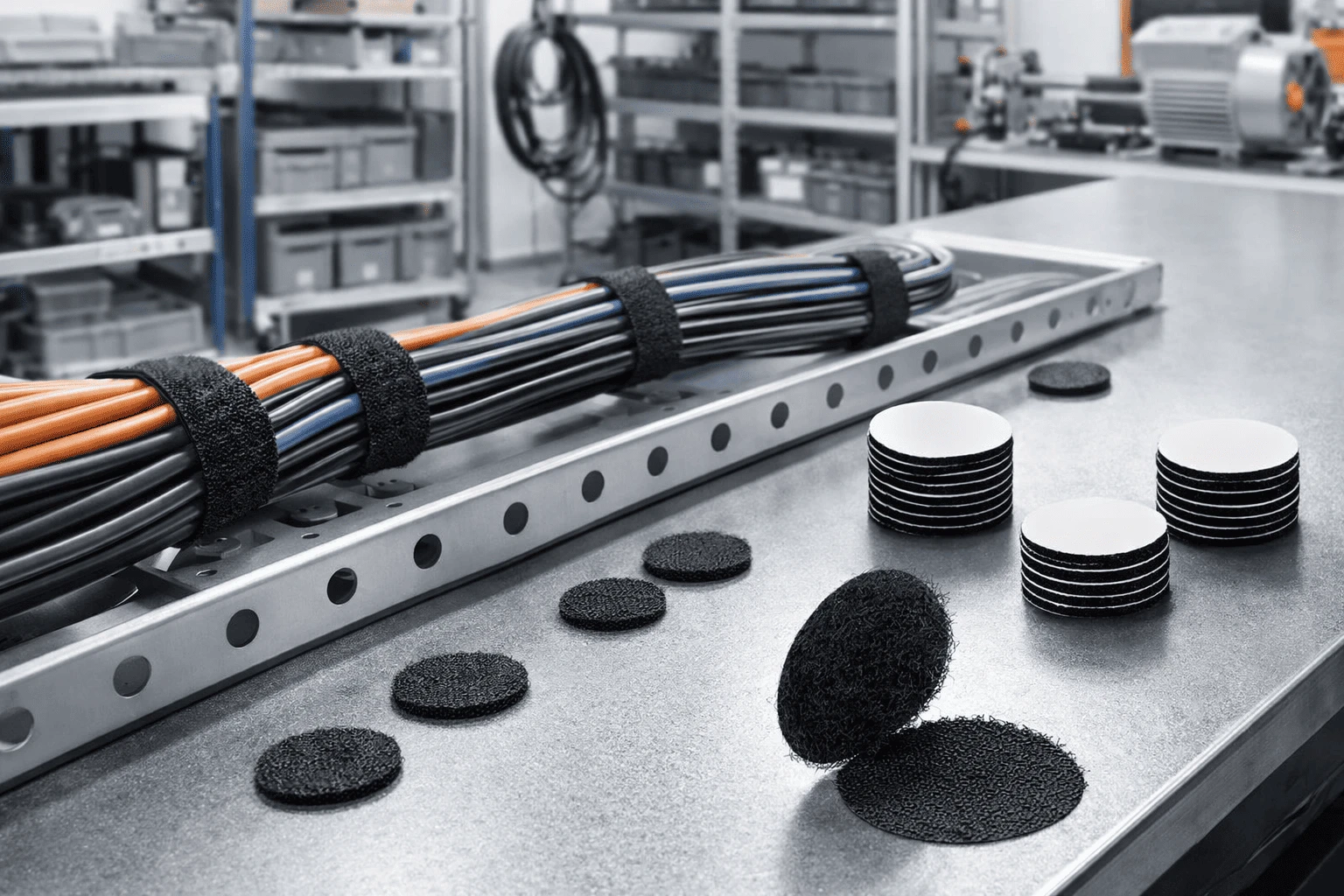
In electrical systems and data infrastructure, hook & loop fasteners are commonly used for bundling and routing cables. They secure cables without compressing them, making adjustments easier during maintenance or upgrades. This approach improves airflow, creates clearer layouts, and supports safer installations.
Manufacturing environments often demand adaptable setups. Hook & loop fasteners are used for temporary fixing, positioning lightweight components, and organising tools or protective coverings. Their flexibility supports lean manufacturing practices, where layouts and processes change frequently.
In print and display applications, hook & loop fasteners provide a clean, re-closable method for mounting panels, posters, and exhibition materials. They enable displays to be updated without leaving residue or causing surface damage, maintaining presentation quality while reducing setup time.
During construction and fit-out projects, hook & loop fasteners are applied for access panels, temporary fixing, and non-permanent installations. Facilities teams also rely on them for maintenance access, providing secure fastening without compromising inspections or future modifications.
Different industrial tasks require different hook & loop formats, depending on surface type, load requirements, and frequency of use. Reusable hook & loop cable ties are widely used in electrical and data environments, securing cables while allowing regular adjustments. Their softer construction reduces the risk of cable damage and improves handling safety. Back-to-back grip straps are commonly applied for bundling hoses, securing equipment, or organising materials in workshops and warehouses. These straps can be cut to length and reused as needed.
Self-adhesive hook & loop coins and squares are frequently used in print, signage, and display work. Their adhesive allows them to bond to common substrates while still providing a re-closable fixing method. For longer applications, adhesive hook & loop tape provides continuous fastening and can be stitched for added security where required. Sew-on hook & loop tape is typically used in textile-based applications, including furniture, curtains, or protective covers, where durability and washability are important. Different hook & loop formats are used in repeated-use scenarios to meet industrial demands, providing reliable fastening across a variety of applications without permanent fixing.
Selection depends on the specific application. Adhesive fasteners work well on smooth surfaces and temporary installations. Sew-on fasteners are better suited for fabrics requiring a more permanent solution. Back-to-back straps are ideal for bundling or adjustable fastening needs.
Performance is influenced by surface cleanliness, texture, and environmental exposure. Smooth, clean surfaces provide optimal adhesion, while temperature fluctuations and vibration must be considered when choosing industrial-grade products.
Colour choice often reflects functional requirements. Black fasteners are common in industrial and cable management environments, while white fasteners are preferred in clean, retail, or textile-based settings where aesthetics matter.
Hook & loop fasteners have become integral in modern industrial environments due to their flexibility, efficiency, and reliable performance. Their ability to support repeated access, reduce installation time, and minimise surface impact makes them applicable across a broad range of operations in the UK. By understanding the strengths and appropriate applications of different formats, businesses can make informed decisions to improve operational efficiency, workplace safety, and adaptability. Properly chosen hook & loop fasteners enhance organisation and contribute to environments that are safer, cleaner, and easier to maintain. For more technical guidance on industrial fastening solutions and material applications, refer to industrialmaterial.uk.

I am Oliver, a blog writer who enjoys creating clear, engaging, and meaningful content for readers. I like exploring different topics and turning ideas into simple, easy-to-understand articles that provide real value. My focus is on writing in a natural and creative way so readers can stay interested and connected. Through my blogs, I aim to inform, inspire, and share useful insights with my audience.
The priorities of modern power distribution systems for high-rises and data centers are efficiency,
18 September 2026
In industrial piping and fluid handling systems, choosing a reliable valve is essential for maintain
7 September 2026
This Cummins 6BT is one of the most reliable Cummins diesel engines produced. It's trusted by truck
18 August 2026
Be the first to share your thoughts
No comments yet. Be the first to comment!
Share your thoughts and join the discussion below.