Sunday, October 4, 2026

Sunday, October 4, 2026
* All product/brand names, logos, and trademarks are property of their respective owners.
In professional outdoor and event environments, flooring plays a far more critical role than simply providing a stable walking surface. Installers working around industrial equipment, temporary infrastructure, and high-footfall areas must account for weight loads, safety standards, environmental exposure, and installation efficiency. Flooring failures in these settings can result in operational delays, safety risks, and increased maintenance demands.
Outdoor and event flooring used in professional contexts must perform consistently under pressure. It needs to support heavy equipment without flexing, maintain grip in wet conditions, and withstand repeated use across multiple projects. In the UK, where outdoor installations are regularly exposed to rain, temperature fluctuations, and uneven ground, material selection becomes especially important.
GRP (Glass Reinforced Plastic) flooring has become a widely adopted solution in industrial and event settings due to its strength, durability, and slip resistance. This article explores how professional installers can assess outdoor and event flooring requirements when working with industrial equipment, with a focus on practical performance rather than promotional claims.
Professional outdoor flooring must meet a unique combination of mechanical, environmental, and safety requirements. Unlike permanent indoor flooring, these installations are often temporary or semi-permanent, yet still expected to perform to industrial standards.
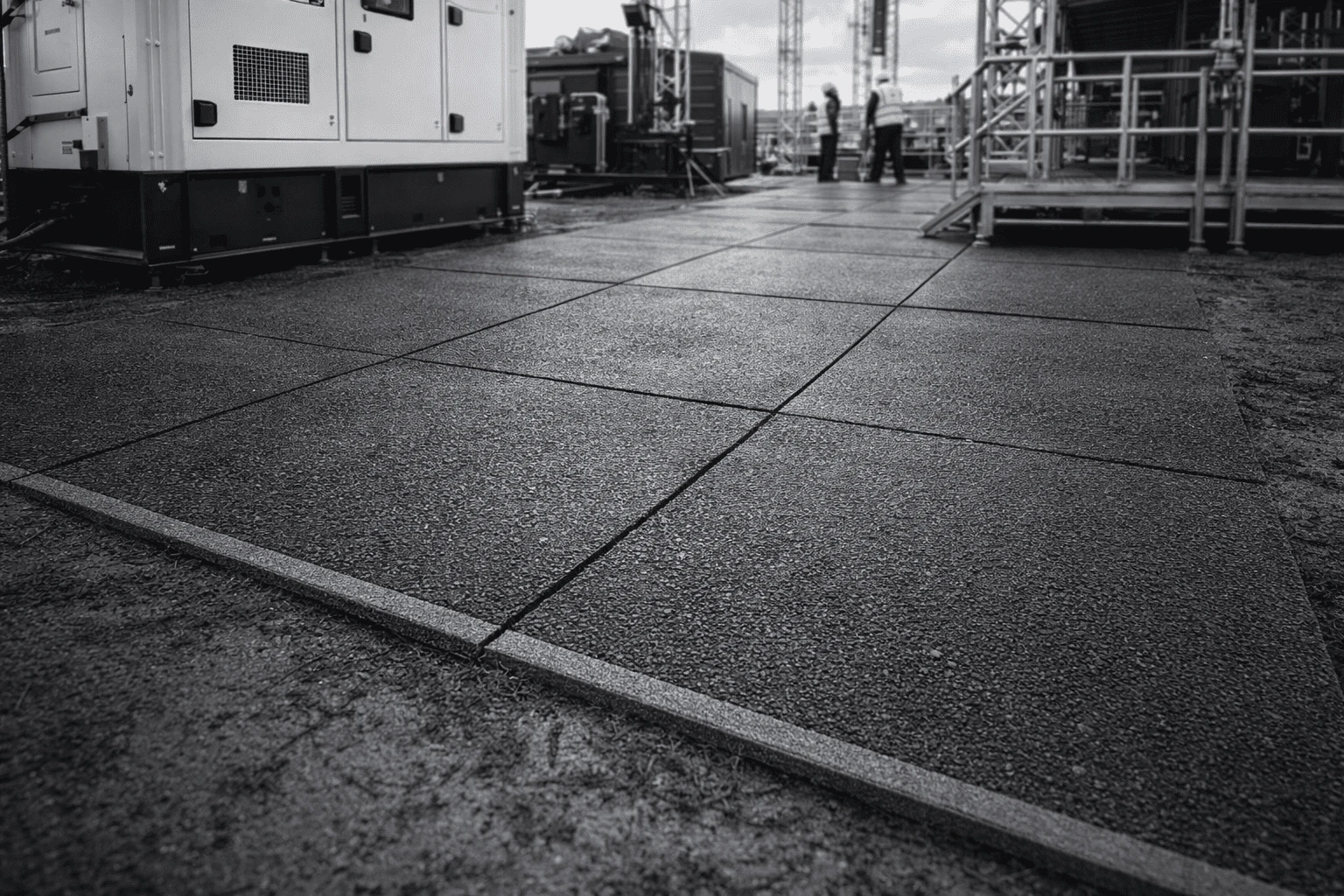
Industrial equipment such as generators, staging systems, access platforms, and plant machinery places concentrated loads on the surface beneath. Flooring that is not designed for these forces can crack, deform, or become unstable, particularly when installed on uneven ground. Professional-grade flooring must distribute weight effectively while maintaining rigidity. GRP flooring is frequently selected in these environments because it offers a strong load-bearing structure without excessive weight, making it easier to handle during installation. This balance is particularly valuable for event and outdoor projects where equipment must be installed and removed efficiently.
Safety considerations are heightened in outdoor environments. Rain, surface debris, and temperature changes can quickly turn inadequately surfaced areas into slip hazards. For installers and site managers, ensuring consistent traction is a core requirement, not an optional feature.
Non-slip surfaces help reduce the likelihood of accidents around machinery and access routes. In many professional settings, flooring must also support compliance with health and safety expectations, particularly where members of the public or large teams are present. Materials that maintain grip under wet or muddy conditions offer a clear functional advantage.
Where installations involve particularly demanding conditions, thicker GRP flooring sheets are often specified to provide additional structural confidence.
A 5mm GRP flooring sheet offers enhanced rigidity compared to thinner alternatives, making it suitable for environments where heavy equipment remains static for extended periods. The reinforced structure helps prevent flexing under point loads, while the non-slip surface supports safer movement around machinery and tools.
This type of flooring is commonly used in areas where both equipment operation and foot traffic occur simultaneously, requiring a surface that performs reliably without constant monitoring.
Heavy-duty GRP sheets are typically used in:
Equipment zones at outdoor events
Temporary working platforms
Access routes around plant and machinery
In these scenarios, the flooring’s performance is measured not just by strength, but by how well it maintains stability and grip throughout the project duration.
From an installation perspective, GRP flooring sheets are relatively straightforward to work with. They can be cut to size on site and fixed using common methods appropriate for temporary or semi-permanent setups. Their durability also means they can be reused across multiple projects, reducing material waste and replacement frequency.
Not all professional outdoor installations involve extreme point loads, but durability and environmental resistance remain essential.
Outdoor flooring in the UK must tolerate frequent exposure to moisture and temperature changes. GRP floor sheets are resistant to water absorption and do not rot, warp, or corrode, making them suitable for repeated outdoor use. This resilience is particularly valuable for event infrastructure and semi-permanent industrial setups, where flooring may be left in place for extended periods without constant maintenance.
Ease of maintenance is a practical concern for contractors managing multiple sites or events. GRP flooring surfaces are typically easy to clean, allowing debris and mud to be removed quickly between uses. This reduces turnaround time and helps maintain consistent surface performance. Over time, this low-maintenance characteristic contributes to a longer service life, especially when compared to materials that degrade more quickly under outdoor exposure.
Outdoor GRP floor sheets are well-suited to:
Event walkways and access paths
Temporary outdoor working areas
Semi-permanent installations requiring a stable footing
Their strength-to-weight ratio makes them particularly useful where flooring needs to be transported, installed, and removed regularly.
Choosing appropriate flooring begins with understanding how the surface will be used throughout the project lifecycle.
Installers should assess whether the flooring will support static equipment, moving loads, or primarily foot traffic. Heavier equipment may require thicker or more rigid flooring to avoid surface deformation, while access routes may prioritise slip resistance and consistent grip. Selecting flooring based on realistic load expectations helps avoid over-specification while ensuring adequate performance. This approach also supports safer working conditions by reducing the likelihood of unexpected surface failure.
Regardless of material quality, installation practices play a major role in overall performance. Proper sub-base preparation helps ensure even load distribution, particularly on uneven ground. Planning sheet layout in advance can also minimise stress points and improve long-term stability. Fixing methods should align with whether the installation is temporary or semi-permanent. GRP flooring offers flexibility in this respect, allowing installers to adapt their approach based on project duration and reuse requirements.
Outdoor and event flooring used in professional installations must perform reliably under conditions that combine heavy loads, environmental exposure, and safety demands. When industrial equipment is involved, material choice becomes a functional decision rather than a cosmetic one. GRP flooring offers a practical balance of strength, durability, and slip resistance that aligns well with these requirements. Thicker, non-slip sheets are well-suited to high-load areas, while standard outdoor GRP floor sheets provide dependable performance for access routes and working platforms.
By focusing on realistic load conditions, safety considerations, and installation practices, professionals can specify flooring that supports both operational efficiency and long-term usability. For those sourcing durable flooring solutions within the UK, further technical information and product guidance can be found at therubbermats.uk.

UK writer Evan covers home improvement, construction, and lifestyle trends, sharing practical insights for readers.
Anyone who has finished a flooring project knows the job isn't quite done once the last plank or til
9 September 2026
Exposed wall corners take more punishment than almost any other surface in a building. From furnitur
4 September 2026
In contemporary architecture and interior design, material choices define not only how spaces functi
9 February 2026
Be the first to share your thoughts
No comments yet. Be the first to comment!
Share your thoughts and join the discussion below.
.webp&w=3840&q=75)